
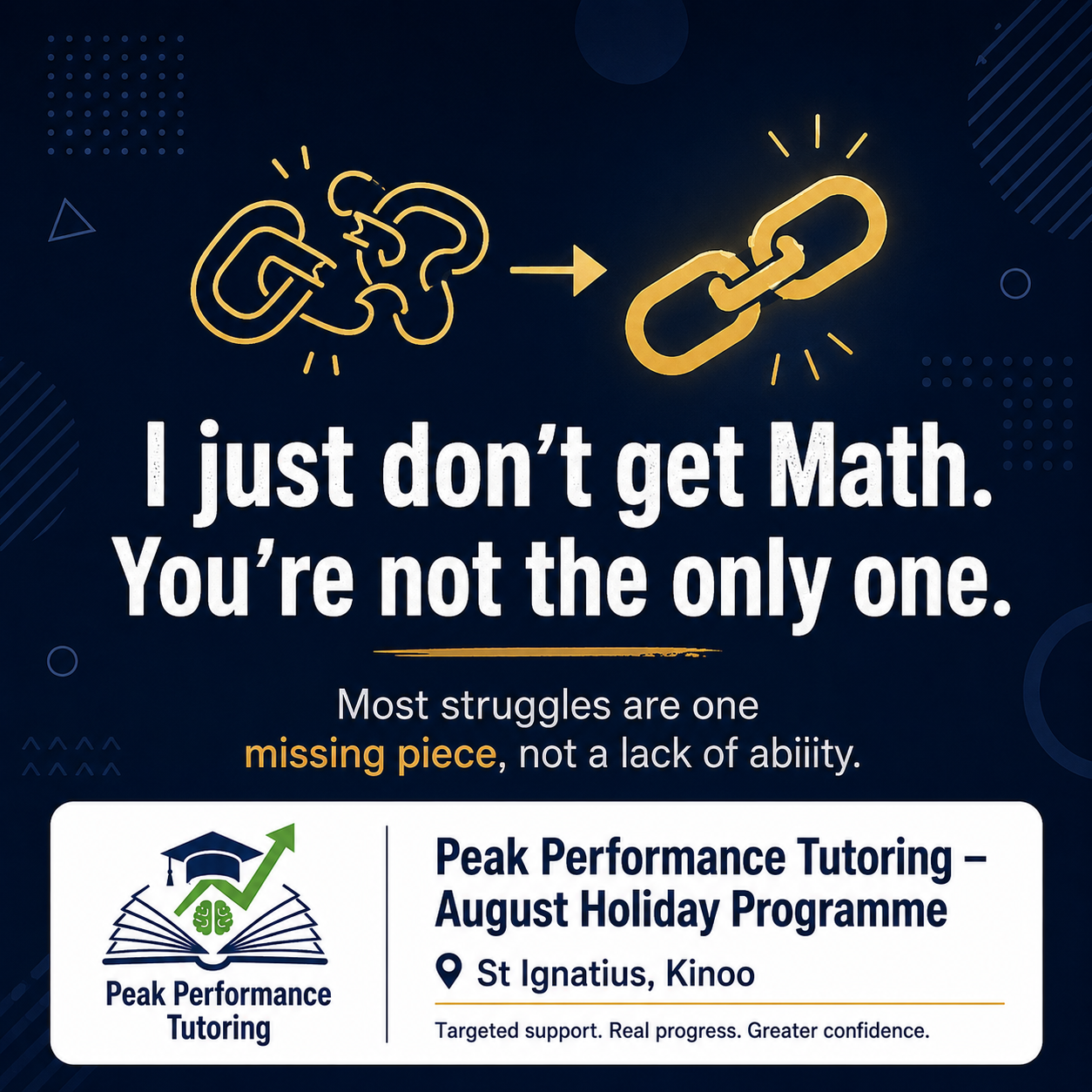
I Just Don't Get Math": Why It's Almost Never About Ability
Somewhere in nearly every classroom in Kenya, there's a student quietly convinced that Math or Chemistry simply isn't for them. They don't say it loudly. They say it once, maybe to a friend, maybe to a parent who doesn't quite know how to respond — "I just don't get it" — and then they carry that belief through every test that confirms it. Here's what almost nobody tells that student: it's usually not true. And the real explanation is both simpler and far more fixable than "I'm not good at this."
Peak editorial note
This article is written to help parents and learners make sharper academic decisions, not just read another school update.
The gap nobody went back to close
Math and Chemistry share a quality that subjects like English or History don't have to the same degree — they're cumulative. Every new topic is built directly on top of the last one. If a foundational idea wasn't fully secured a year, or even a few months, ago, it doesn't just disappear. It sits underneath everything that comes after it, quietly making each new topic harder to grasp than it should be.
This is why simply revising "this term's work" so often fails to help. The student isn't struggling with what's in front of them right now — they're struggling with something further back that was never properly closed. Going over the current topic again and again doesn't reach that gap. It just adds another layer on top of an already unstable foundation.
From the outside, this looks like a student who "isn't good at Math." From the inside, it feels like falling further behind no matter how much extra revision happens.
Why this gets misdiagnosed so often
The natural response to a struggling grade is to add more hours: more revision, more practice papers, more repetition of the same material. It's an understandable instinct, but it treats the symptom, not the cause.
A student who is two topics behind on a foundational concept doesn't need more of the current topic — they need that earlier gap identified and rebuilt, specifically. Without that step, more tuition often just means more time spent confused, which tends to do quiet damage to confidence long before it shows up clearly on a report card.
What actually closes the gap
This is the starting point that matters more than anything that comes after it: before any new teaching begins, the real gap has to be found. Not guessed at. Diagnosed properly, against where a student's understanding genuinely starts to break down — sometimes a full topic, occasionally a full year, behind where they currently sit.
Once that's clear, the next requirement is just as important: being grouped with students at a similar actual level. A student rebuilding a foundational gap learns very differently from one who's already solid and chasing precision for an A. Put in the same room moving at the same pace, one of them is left behind and the other is held back — and neither one moves much at all.
This is the model behind Peak Performance Tutoring's August holiday programme: a real diagnostic first, then small, ability-matched groups built around what that diagnostic actually shows, rather than what grade or age a student happens to be.
The reframe that matters most
A student who says "I just don't get Math" has usually already decided something quietly damaging about themselves — that the problem is who they are, not where one piece went missing along the way.
It rarely is. Most of the time, there's one specific gap, a few topics back, that's been left unaddressed for far too long. Once it's found and closed, the topics built on top of it tend to make sense far faster than expected — not because the student suddenly became different, but because the actual obstacle was finally removed.
📍 Peak Performance Tutoring, St Ignatius, Kinoo — August Holiday Programme 🌐 peakcampus.co.ke
📘 Follow us on Facebook for study tips, revision strategies, and programme updates: facebook.com/tutoringpeakperformance
Comment "INFO," send us a DM, or tell your parent to get in touch.
Quick parent takeaway
The strongest tuition decisions are made early: identify the learner's weak areas, place them in the right class track, and keep feedback visible until performance changes.
Read next